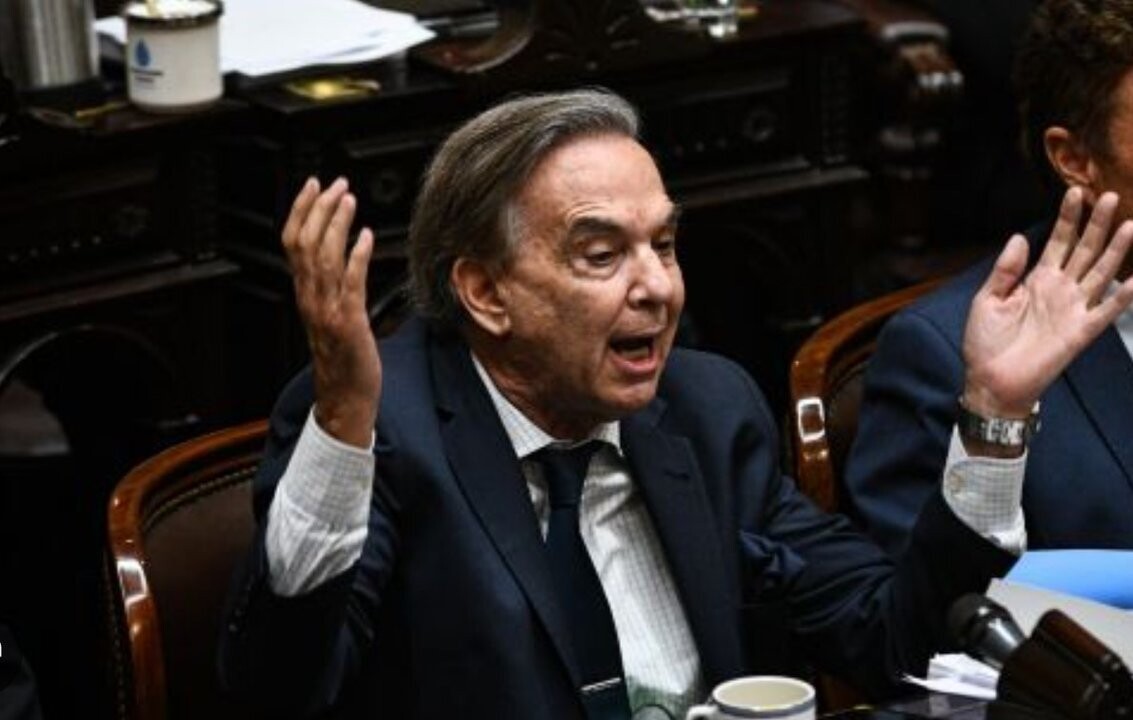
Buenos Aires, November 26 (NA) – The Encuentro Federal block, led by Miguel Pichetto, is under threat of rupture as negotiations to unite with deputies elected by Provincias Unidas have become entangled. However, there is still a chance to articulate all the loose pieces of the opposition center into a new integrating interblock.
The axis of the dispute is the presidency of the hypothetical new interblock: Pichetto wants to keep the presidency, but the governors of Santa Fe, Maximiliano Pullaro, of Córdoba, Martín Llaryora, and of Chubut, Ignacio “Nacho” Torres, demand that leadership fall to a representative of the provincial powers, and in this sense, they are pushing for the name of the outgoing vice governor of the first of those provinces, Gisela Scaglia.
Without waiting for a dialogue with Pichetto, the governors set up camp in Buenos Aires and managed to commit to a block of “at least 16 legislators,” some of whom were until today in Encuentro Federal under the orbit of the native of Río Negro, such as Loma Ávila and Esteban Paulón.
This Wednesday, Pullaro, Torres, and the vice governor of Córdoba, Myrian Prunotto (on behalf of Llaryora, who could not travel to Buenos Aires because he is preparing for a surgical intervention in his province) met in an office in Congress to organize the landing of Provincias Unidas in the Chamber of Deputies and to outline the policy of alliances.
They sounded out an integrating agreement, but there were no significant advances.
“The governors tried to impose Scaglia overnight, so as of today everything is broken,” summarized, with anger, a national deputy very close to Pichetto in statements to the Argentine News Agency (NA).
In the middle of this crossroads, Pichetto is threatening to form his own separate block with Nicolás Massot. A national deputy who has one foot in Encuentro Federal and the other in Provincias Unidas admitted to NA that the current “is not the best scenario,” that Pichetto “is hurt” because “he found out in the press” that Provincias Unidas was going to take over the block, but affirmed that “in politics there is always time to recompose.”
“If there is goodwill, the governors should pick up the phone and talk to him directly, that his trajectory and his work be recognized,” he pointed out, diplomatically.
Within the aquarium of radicalism, Provincias Unidas has secured the porteños Martín Lousteau and Mariela Coletta, the bonaerense Pablo Juliano, and the jujeños Jorge “Colo” Rizzotti and María Inés Zigarán. On the other hand, the correntino Diógenes González is in doubt, who awaits instructions from the radical governor Gustavo Valdés, who has been torn between his party affiliation and his insertion into Provincias Unidas.
If Valdés were to accept the presidency of the National Committee of the UCR, as they are proposing to him, he would have little room to frame his deputy in a block outside the party of the century.
Other deputies who will group into Provincias Unidas are the aforementioned Scaglia (who comes from PRO but responds politically to Pullaro), the Santa Fe socialists Paulón and Pablo Farías (the latter is led by Pullaro), six Córdoba deputies who report to Martín Llaryora, and the Chubut unionist “Loma” Ávila.
Those in doubt are the Santa Cruz deputy José Luis Garrido, who awaits the decision of Governor Claudio Vidal, and the Entre Ríos deputy Francisco Morchio, who will decide his fate next week together with his governor Rogelio Frigerio.
Regardless of the versions about the fragmentation of the opposition center forces, the issue is still “solvable” and could be settled through the formation of an interblock with a collegiate “inter paribus” leadership, coordinated by Scaglia, this medium learned from high parliamentary sources.
To this interblock, whose name is still being considered, other independent deputies could join, such as the two “lilitos” from the Civic Coalition, Maximiliano Ferraro and Mónica Frade, and the former libertarians from Coherencia Marcela Pagano and Lourdes Arrieta.
A common aspiration of all these center forces, which worked shoulder to shoulder with an opposition imprint during 2025, is to become the third force outside the meat grinder of the polarization between La Libertad Avanza and Fuerza Patria.
Holding that status will allow them to secure the third vice-presidency and obtain a greater number of representatives in the commissions, such as those on Budget, Labor Legislation, Criminal Legislation, and Constitutional Affairs, which will have to be constituted in the very short term to work on the agenda of extraordinary December sessions.
In their eagerness to associate, these opposition center forces are more moved by pragmatism than by political affinities, which also exist.
“The context makes it necessary for us to join more force out of familiarity and closeness. This year those of us in Encuentro Federal, Democracy Forever, and the Civic Coalition worked well together. If we were to reach 23 members, we could have a presence in the DNU commission. Today we are far from it,” confessed a national deputy from Provincias Unidas who is aware of the negotiations, in dialogue with Noticias Argentinas.
The direct competitor of this hypothetical interblock fed by the governors of Provincias Unidas is another interblock that a second group of governors closer to the Government (headed by the Salta Gustavo Sáenz) is putting together on the basis of what was Federal Innovation.